National Anti-Drone Systems Successfully Secure NATO Summit
Anti-drone systems developed under the coordination of Türkiye's Presidency of Defence Industries (SSB) played a vital role in ensuring airspace security during the NATO Summit, serving as one of the key force multipliers for security personnel.

İLTER J400 Yapay Zeka Desteki Drone Tespit ve Engelleme + İLTER HSPAR E/O Drone Tespit Sistemleri
One of the central topics at the summit, hosted by Türkiye, was the growing need for effective countermeasures against unmanned aerial systems (UAS), which have become a defining feature of modern warfare and a decisive factor on today's battlefield.
During the summit, NATO announced the Drone Edge Initiative, aimed at establishing an integrated defense framework capable of detecting, identifying, and neutralizing drone threats. Under the initiative, Allied nations are expected to invest more than $40 billion in anti-drone capabilities over the next five years.
The initiative prioritizes the rapid deployment of a broad range of technologies, including drone detection radars, RF sensing systems, electro-optical sensors, electronic jamming, GNSS spoofing, laser-based and kinetic defeat systems, and advanced command-and-control software.
İLTER (TUNÇ) MRKAS Mobil Radarlı Karıştırma ve Aldatma Sistemi
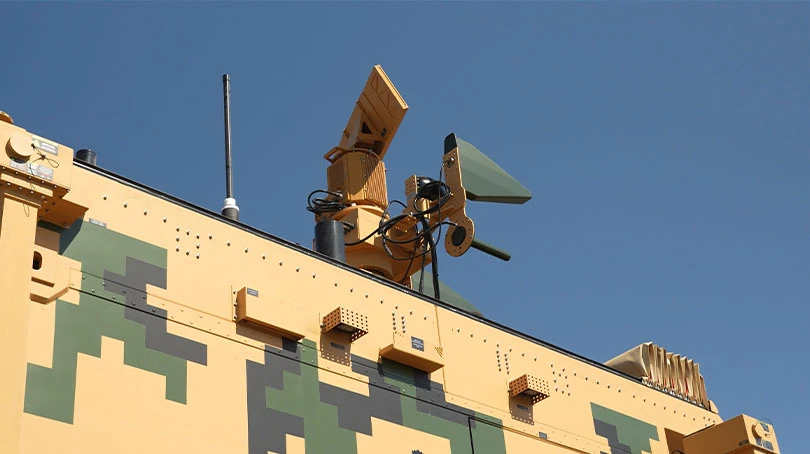
Anti-drone solutions are generally categorized into passive systems, which focus on detection and identification, and active systems designed to neutralize threats. Active measures are further divided into soft-kill solutions, which disrupt or disable drones without causing physical damage, and hard-kill systems that physically destroy the target.
In recent years, the Turkish defense industry has significantly expanded its capabilities across all of these categories under the coordination of the Presidency of Defence Industries. These domestically developed solutions have entered service with Turkish security forces while also achieving notable export success. Several of these systems were successfully deployed during the NATO Summit in Ankara.
Boğaziçi Defence Technologies contributed to the summit's security with a layered anti-drone architecture integrating RF detection, radar, electro-optical sensors, electronic jamming, and GNSS spoofing capabilities. The company's indigenous anti-drone systems were actively employed to safeguard the airspace during the high-level gathering of heads of state and government.
Throughout the summit, critical locations were protected by the company's advanced İLTER family of systems. The deployment included the long-range İLTER J400 electronic jammer, the İLTER HSPAR (Hybrid Active Scanned Phased Array Radar), and an AI-enabled electro-optical tracking system. Also deployed was the İLTER MRKAS, one of Türkiye's most advanced anti-drone systems, which was delivered to the Turkish Gendarmerie General Command earlier this year under a joint project carried out by the Presidency of Defence Industries and Boğaziçi Defence Technologies.
The AI-powered İLTER family integrates target detection, identification, tracking, and electronic neutralization capabilities within a unified command-and-control architecture. Throughout the NATO Summit, the systems played a critical role in maintaining airspace security, demonstrating high operational performance and successfully completing their assigned missions.
Having previously been performed to protect critical infrastructure, strategic facilities, and major international events, these advanced indigenous solutions added another successful operational mission to their proven track record during the NATO Summit.
News linki: https://www.aa.com.tr/tr/bilim-teknoloji/milli-dron-karsi-tedbir-sistemleri-nato-zirvesinde-basariyla-gorev-yapti/3996280